Alef Castable Abutments


Need several sizes or types at once? Build an order list here, then add the whole list to your cart in one step. This is separate from the Add to cart button above, and your order list is saved on this device until you add it to the cart.
Product details & FAQ
Castable abutments let the laboratory create a fully customized abutment shape in the material of its choice. This page collects every castable option for the Alef internal-hex implant in one place: standard castable abutments, castable abutments with shoulder, angled castable abutments with shoulder, castable abutments on a titanium base, and castable abutments on a chrome-cobalt base.
Standard castable abutments
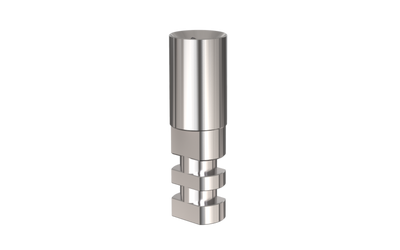
The standard castable abutment (Ø3.75 mm, 10.5 mm high) comes in a non-rotational version (CANR), with an anti-rotation hex, for single units, and a rotational version (CAR) for splinted work and bridges.
Castable abutments with shoulder
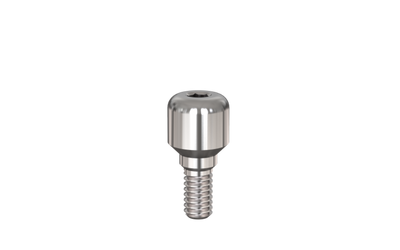
The non-rotational castable abutment with shoulder (CANR1–CANR3) is offered with collar heights of 1, 2 and 3 mm, so the margin can be positioned according to soft-tissue depth. Angled versions of 15° (CA15NR1–CA15NR3) and 25° (CA25NR1–CA25NR3) are available for cases that need axis correction.
Castable abutments with a titanium or chrome-cobalt base
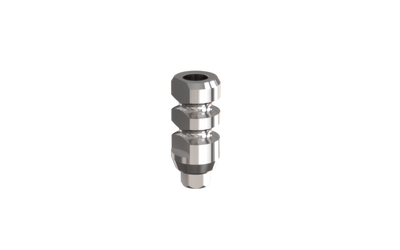
The castable abutment with titanium base (CATB, Ø4.5 mm, 10.5 mm high) provides a machined titanium connection with a castable upper part. The chrome-cobalt base versions (CCR rotational, CCNR non-rotational, Ø4.0 mm, 11 mm high) give a cast-on option with a CoCr interface. The type of base determines the connection quality, so choose the version your laboratory workflow requires.
Specifications
- Connection: Alef internal hex, Ø3.5 mm platform
- Maximum recommended torque: 20 Ncm for castable abutments; 35 Ncm for castable abutments with a titanium or CoCr base
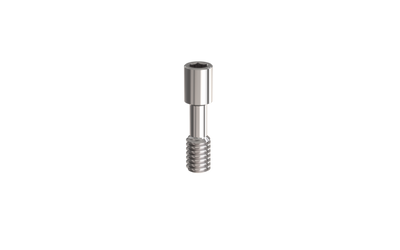
- Abutment screw: ALAS
- Rotational and non-rotational options
How to choose
First decide whether the restoration is single-unit (non-rotational) or splinted (rotational). Then decide whether you need a shoulder and collar height, an angled version, or a titanium/CoCr base. Select the type and version above; the reference code is shown for each combination. The torque values are maximum recommendations and should not replace the clinician’s judgment.
Regulatory
MSDI products meet the highest standards set by the FDA, CE MDR, ISO 13485 and other regulatory bodies. Disclaimer: some products may not have regulatory clearance for sale in specific territories. Please read the instructions for use (IFU) before use.
Frequently asked questions
What is the difference between rotational and non-rotational?
Non-rotational abutments have an anti-rotation hex and suit single units; rotational abutments have no hex and suit splinted restorations and bridges.
Which castable has a metal base?
CATB has a titanium base; CCR and CCNR have a chrome-cobalt base.
What torque applies?
20 Ncm for castable abutments and 35 Ncm for versions with a titanium or CoCr base.
Where do I find the IFU?
At eifu.msdi-dental.com.
Can the team advise on the right laboratory workflow?
Yes, use the contact option on this site.
Complete your case
Components that are usually ordered with this item.