Alef Ti-Base Abutment

Product details & FAQ
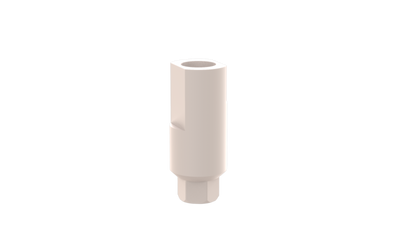
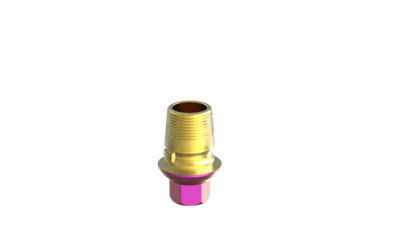
A Ti-base is the titanium interface on which a milled or pressed crown or abutment is bonded. It joins the digital workflow to the Alef implant connection: the laboratory designs and mills the upper part, and the Ti-base provides a precise, titanium-to-titanium connection to the implant. This page covers the standard Alef Ti-bases and the Sirona-compatible Ti-bases in rotational and non-rotational versions.
Standard Ti-base abutments
Standard Ti-bases (Ø4.5 mm) come in a non-rotational version (TBNR05, TBNR15, TBNR25), with an anti-rotation hex, for single crowns, and a rotational version (TBR00, TBR05, TBR15, TBR25, TBR35, TBR45) for splinted or bridge work. The collar height, from 0 mm to 4.5 mm, sets the level of the bonding surface relative to the soft tissue.
Sirona-compatible Ti-base abutments
The Sirona-compatible Ti-bases (Ø4.3 mm) are offered in rotational (STBR05, STBR15, STBR30) and non-rotational (STBNR05, STBNR15, STBNR30) versions, with collar heights of 0.5, 1.5 and 3.0 mm, for laboratories working in that design environment.
Specifications
- Connection: Alef internal hex, Ø3.5 mm platform
- Standard Ti-base: Ø4.5 mm; Sirona-compatible: Ø4.3 mm
- Rotational and non-rotational versions
- Maximum recommended torque: 35 Ncm
How to choose
Decide first whether the restoration is single-unit (non-rotational) or splinted (rotational), then select the collar height according to the soft-tissue depth. Select the type, rotation and collar above; the reference code is shown for each combination. Torque values are maximum recommendations and should not replace the clinician’s judgment. For a scan body to capture the implant position, see the Alef scan body.
Regulatory
MSDI products are CE MDR certified and made under ISO 13485. Regulatory status varies by market. Please read the instructions for use (IFU) before use.
Frequently asked questions
What is a Ti-base?
A titanium interface that connects a bonded CAD/CAM crown or abutment to the implant.
Rotational or non-rotational?
Non-rotational for single units, rotational for splinted restorations and bridges.
What torque should I use?
Up to 35 Ncm.
Where can I find instructions for use?
At eifu.msdi-dental.com.
Complete your case
Components that are usually ordered with this item.